Your website could be quietly damaging both your business performance and the planet. The internet now produces more carbon emissions than the entire aviation industry – and most businesses have no idea their website contributes to this growing environmental crisis. It’s important to be aware of your website carbon footprint.
Here’s what should concern every UK business owner: a single poorly optimised website visit can generate over 20 grams of CO2. Multiply that by thousands of monthly visitors, and your digital presence could be producing tonnes of unnecessary carbon emissions whilst simultaneously driving away customers with slow loading speeds.
The solution isn’t choosing between performance and sustainability – the most environmentally friendly websites are also the fastest, most profitable, and highest-ranking sites on Google.
The Hidden Business Cost of Dirty Hosting
Every time someone visits your website, energy gets consumed at three critical points: the data centre hosting your site, the networks transmitting your content, and the user’s device displaying your pages. Choose the wrong hosting provider, and you’re not just harming the environment – you’re sabotaging your business performance.
Traditional hosting companies rely on fossil fuel-powered data centres that produce massive carbon emissions. But here’s the business reality that matters more to most owners: dirty hosting typically means outdated infrastructure, slower servers, and worse website performance.
Google’s algorithm now directly rewards fast, efficient websites through Core Web Vitals rankings. Environmental responsibility isn’t just good corporate citizenship – it’s essential for digital marketing success. Your hosting choice affects your search rankings, customer experience, and bottom line.
UK businesses face another critical consideration: increasing environmental regulations and consumer expectations. Recent studies show 73% of UK consumers prefer environmentally responsible companies. Your website’s carbon footprint directly impacts brand reputation and customer loyalty.
How Much Damage Is Your Website Actually Causing?
Most business owners have no idea their website’s environmental impact – or how it compares to competitors. The Website Carbon Calculator reveals your site’s carbon footprint in seconds, measuring emissions per page view and annual environmental impact.
The results often shock business owners. A typical business website produces 4.6 grams of CO2 per visit, but poorly optimised sites can generate 10 times more. E-commerce sites with unoptimised images, excessive plugins, and inefficient code routinely exceed 20 grams per page view.
Calculate this across your annual traffic: 10,000 monthly visitors on a 10-gram-per-visit website produces 1.2 tonnes of CO2 annually – equivalent to driving 3,000 miles in a petrol car. For high-traffic websites, carbon emissions can exceed those of small businesses’ entire physical operations.
But here’s the critical business insight: websites with high carbon footprints invariably suffer from poor performance, high bounce rates, and low search rankings. Environmental damage and business damage go hand in hand.
- All websites0.33 g
Static site generators
- Jekyll0.12 g
- Astro0.16 g
- Hugo0.17 g
- Gatsby0.26 g
- Next.js0.31 g
- Nuxt.js0.38 g
Content management systems
- Drupal0.33 g
- Wix0.35 g
- WordPress0.38 g
- Joomla0.39 g
- Squarespace0.50 g
E-commerce platforms
- Shopify0.38 g
- PrestaShop0.39 g
- WooCommerce0.43 g
- Magento0.59 g
The line marks the median web page, 0.33 g. Sites built with lean static site generators such as Jekyll, Astro and Hugo come in at around half of that or less, while every content management system and e-commerce platform shown sits at or above it – Magento highest at 0.59 g.
Source: HTTP Archive Web Almanac 2024, Sustainability chapter, using the Sustainable Web Design Model v4. Selected platforms; the table has desktop and mobile figures for all of them.
Show the figures
| Platform | Desktop | Mobile |
|---|---|---|
| All websites | ||
| Leanest 10% of pages | 0.08 g | 0.07 g |
| Median page | 0.37 g | 0.33 g |
| Heaviest 10% of pages | 1.47 g | 1.36 g |
| Static site generators | ||
| Jekyll | 0.11 g | 0.12 g |
| Astro | 0.16 g | 0.16 g |
| Hugo | 0.16 g | 0.17 g |
| Gatsby | 0.32 g | 0.26 g |
| Next.js | 0.34 g | 0.31 g |
| Nuxt.js | 0.44 g | 0.38 g |
| Content management systems | ||
| Drupal | 0.36 g | 0.33 g |
| Wix | 0.45 g | 0.35 g |
| WordPress | 0.42 g | 0.38 g |
| Joomla | 0.42 g | 0.39 g |
| Squarespace | 0.57 g | 0.50 g |
| E-commerce platforms | ||
| Shopify | 0.41 g | 0.38 g |
| PrestaShop | 0.44 g | 0.39 g |
| Squarespace Commerce | 0.57 g | 0.39 g |
| WooCommerce | 0.46 g | 0.43 g |
| Wix eCommerce | 0.50 g | 0.50 g |
| 1C-Bitrix | 0.47 g | 0.54 g |
| Magento | 0.50 g | 0.59 g |
The Green Hosting Revolution: Performance Meets Responsibility
Switching to green hosting isn’t just environmental virtue signalling – it’s often the fastest way to improve website performance whilst reducing operational costs. Green hosting providers typically invest in modern, efficient infrastructure that delivers superior speed and reliability.
Several UK hosting providers now offer 100% renewable energy hosting, whilst others focus on carbon offsetting programmes. International options include GreenGeeks, which matches energy consumption with three times the renewable energy credits, and major cloud platforms making significant environmental commitments.
AWS aims for 100% renewable energy by 2025, whilst Google Cloud has been carbon neutral since 2007 and targets carbon-free energy by 2030. These platforms combine environmental responsibility with enterprise-grade performance and reliability.
At 37 Digital, we’ve made the commitment to 100% green managed hosting for all our client websites through our website hosting and support services, ensuring that environmental responsibility is built into every project from the ground up.
The business benefits extend beyond environmental credentials. Green hosting providers often offer transparent pricing, better customer support, and modern infrastructure that traditional hosting companies struggle to match.
Website Optimisation: The Sustainability Strategy That Boosts Profits
The most effective way to reduce your website’s carbon footprint is aggressive performance optimisation – which coincidentally delivers the biggest business benefits. Every environmental improvement typically increases conversion rates, search rankings, and customer satisfaction.
Image Optimisation: Cut Emissions and Loading Times Images account for 50-70% of website data transfer and carbon emissions. Converting to modern formats like WebP and AVIF reduces file sizes by 25-50% whilst maintaining visual quality. The business impact is immediate: faster loading speeds, better mobile performance, and improved search rankings.
Implementing responsive images prevents users downloading oversized files for their devices, whilst lazy loading reduces initial page weight. These optimisations cut carbon emissions whilst dramatically improving user experience on mobile devices.
Code Efficiency: Less Energy, More Performance Bloated code doesn’t just waste energy – it destroys website performance. Minimising CSS and JavaScript files, removing unused plugins, and optimising database queries reduce server energy consumption whilst improving loading speeds.
Every unnecessary plugin or script creates additional HTTP requests that consume energy and slow down your website. Streamlining your website’s codebase simultaneously reduces environmental impact and enhances user experience.
Content Delivery Networks: Global Reach, Lower Impact CDNs reduce carbon emissions by serving content from geographically closer servers, minimising data travel distance and energy consumption. Modern CDNs like Cloudflare operate on renewable energy and offer significant performance improvements for UK businesses targeting international markets.
Caching: Maximum Efficiency, Minimum Energy Effective caching reduces server load by serving stored page versions rather than generating content repeatedly. For high-traffic websites, this dramatically cuts energy consumption whilst delivering instant loading speeds for returning visitors.
The Competitive Advantage of Sustainable Web Practices
Environmental responsibility isn’t just good corporate citizenship – it’s becoming a competitive necessity. UK businesses increasingly face environmental reporting requirements, and website sustainability supports ESG goals whilst delivering measurable business benefits.
Search engines favour efficient, fast-loading websites. Google’s Core Web Vitals directly incorporate performance metrics that align with environmental best practices. Sustainable web development improves search rankings whilst reducing hosting costs and environmental impact.
Consumer behaviour increasingly rewards environmental responsibility. A demonstrably eco-friendly website enhances brand reputation, supports marketing messages about corporate values, and influences purchasing decisions in competitive markets.
The cost benefits are substantial. Efficient websites require fewer server resources, reducing hosting expenses and bandwidth costs. For high-traffic websites, these savings can offset optimisation investments within months whilst delivering ongoing environmental and performance benefits.
Making the Switch: Your Sustainable Website Strategy
Start by measuring your current environmental impact using the Website Carbon Calculator and Green Web Foundation tools. These reveal optimisation opportunities whilst providing baseline metrics for tracking improvements.
Prioritise high-impact changes: green hosting migration, image optimisation, and caching implementation. These foundational improvements deliver the largest environmental and performance benefits with manageable technical complexity.
Develop ongoing sustainability practices: regular performance audits, image optimisation standards, and third-party integration policies. Environmental responsibility requires systematic approach rather than one-time optimisation.
Consider implementing a sustainability statement highlighting your environmental commitments and green hosting choices. Transparency demonstrates corporate responsibility whilst potentially influencing customer decisions in competitive markets.
The Future Is Sustainable – And Profitable
Sustainable web development isn’t environmental idealism – it’s smart business strategy that improves performance, reduces costs, and enhances customer relationships. The alignment between environmental practices and website performance makes sustainability a competitive advantage rather than operational burden.
Emerging technologies continue improving sustainability options: edge computing reduces data travel, AI optimisation automatically improves efficiency, and renewable energy adoption expands across hosting infrastructure. Early adoption positions businesses advantageously for future environmental regulations and consumer expectations.
At 37 Digital, we help UK businesses implement sustainable web practices that reduce environmental impact whilst improving website performance and search rankings. Our SEO and digital marketing services include comprehensive optimisation that delivers both environmental and business benefits.
Ready to reduce your website’s carbon footprint whilst boosting performance and profits? Contact us today to discover how sustainable web practices can transform your digital presence and business results.
Update – October 2026: We’ve recently relaunched our website, rebuilt from scratch, so we put it back through the Website Carbon Calculator. We’re proud to report it still achieves an A rating and is cleaner than 83% of all web pages tested globally.
Under the bonnet, the new site is built with Next.js 15 and React 19, written in TypeScript and styled with Tailwind CSS. WordPress still looks after our articles, but only as a headless CMS behind the scenes – pages are pre-rendered and served from cache rather than built on every visit. Site images are converted to AVIF and WebP when the site is built and served at the right size for each screen, and our two fonts are self-hosted variable files, so there are no extra calls to third-party font services.
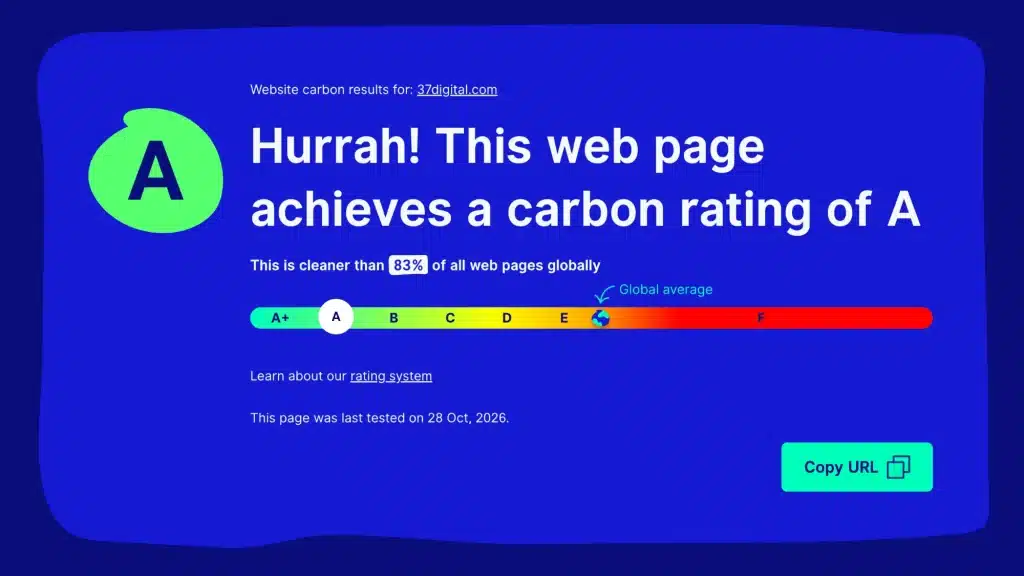
See the full result for 37digital.com, or test your own website.